Tuesday, 27 August 2019

Us


Watch as director Jordan Peele dances around the ties and trademarks of a threadbare genre and then renders these tropes irrelevant with splenetic bites of satire and an audaciously intellectual pulse. He continually penetrates the horror genre with an irreverently political edict. Beautifully controlled, the macabre quality of the film lives in the slow pace of the film, the eerie sounds, the heavy political undertone and the unusual acts that are buried within the false safety of the many mundane ones. It feels oddly pedestrian, heavy in awkward symbolism as Peele struggles to strings together each concept, playing with and challenging its expectant audience. He wraps each frame in an echoing hypnotic rhythm, skeletons of Eminem's Five On It, manipulated, cut and thrown into various points of the film. 

While Peele's debut Get Out rests more heavily on a singular concept, in Us, Peele ventures further, affording greater depth, thought and consequence to his depiction of enduring systematic racism. This is his answer to "post-racial" America, a satirical, absurdist piece that seeks to incorporate his understanding of mythology, human nature and postmodern culture. 

The innumerable plot holes frustrate and antagonise the audience, but Peele relinquishes clarity and grace for the beauty bought by the vague and loosely defined, indulging in the space for interpretation created by the non-specificity of his frames. Rich in playful detail, in political commentary and perfectly measured, Us buys fully into antiquated satire, a piece of cinema drenched in symbolism, relying heavily on the horror of motifs. The film is affected by a chilling score woven with afro-beats and symphonic nuances. Disquieting moments are disturbed by sudden, unnatural movements, quick and constant plot twists to create a continuing guess game. 

Monday, 13 March 2017

Moonlight


Moonlight concludes at a cathartic moment: the camera closes in on Chiron comforted in loneliness by a lost love before cutting away to the visual of a smooth black head turning back to pierce the fourth wall, a dewey orb of darkness set against the moonlit seascape. The film's power is captured precisely in its conclusion as it provides no payoff, only the real succession and consequence of choices and mistakes made in a lifetime, plagued by an unyielding realism. This sentiment is echoed in its technical style. Moonlight takes the form of a series of moving moments that linger too long, a closeup that never relents, invading the audience with the harshness and helpless of every character's condition. It is a piece of cinema confirming substance to lie within the style, living in the music and the imagery, in the beauty of suggestion, nuance and interpretation. The dizzying concoction of grief, violence and torment, a carefully selected orchestra of events that culminate to an emotional climax where the film descends into a fever dream. Judgment blurs and characters act on whim and instinct and desire and the story is pushed into its next chapter. 

There is a quality of the unremarkable in Moonlight's intrinsic story. A young boy is neglected by his crackhead mother, bullied as a teenager, finds solace in lust and intimacy and as an adult is empty, lost and lonely. But herein lies the distinctive power of Moonlight: its essential character of humanness. There is push to develop its characters beyond their short name: the crackhead mother and hard drug dealer are not incapable but merely constrained in their ability to give Chiron the love and care he needs. The specificity and smallness of its story prove no bar to its reach and relevance. It is a piece of cinema delicate and profound in its soulful resolution.

Saturday, 21 January 2017

Paterson


Paterson finds the tiny fragments of poetry which trickle through routine and rest in the crevices of ordinary life, swimming in the details of a particular place or person, hiding in patterns, in serendipity, and the largeness which affects the smallness of an individual. The feature evokes a stirring, patient kind of understated, suggesting there to be beauty found in rearranging the prosaic humdrum of mediocrity into pretty words, a sweet verse. The words written by Paterson (Adam Driver) are done so without a definable purpose. Paterson relishes in the pleasure of deconstructing his day to day with clunky metaphors and strangely profound prose. Every day is miles driven in a local bus blocks around a small town, strokes of a pen forming an ongoing love sonnet, and the patient words exchanged between a pensive man and his idiosyncratic, somewhat facetious lover.  

Paterson's poetry is far from exceptional, it is pure and unadulterated, tranquil, free from pretense or any forged grandeur but more often than not it lacks the elegance and sophistication of published work. This is verse quite plainly coming from an ostensibly content man who desires nothing more than what he already has, a fascinating concept given the dull, uneventful and routine nature of his existence. He rises early, but not before first cherishing a few moments in bed with the sleeping silhouette of his beautiful wife, eats alone, scribbles a few meditative lines at his driver seat before being interrupted to start work. Throughout his day, he finds time to set ink to his small book of poetry, he listens in to the snippets life he can steal from the conversations of his passengers and the fragments of community and drama he encounters at the dive bar he frequents. 

Monday, 8 August 2016

Visual & Sound Diary: Paris, Texas


To romanticise loneliness is a guilty pleasure, a sweet and shameful joy. Paris, Texas, a slow-burning mediation on the luxuries of isolation and escape, is a film of retrospective melancholy, flooded with a ripe air of mystery, implicit devastation and so exquisitely focused on detail, motion and silence. Wim Wenders is not the kind of filmmaker to stitch on superfluous super 8 camera footage simply to instill some forged sense of nostalgia. He uses every mechanism and technical nuance of cinema to capture the missing and unattended parts of a story told so often. The beauty lies in the strangely traditional nature of its background story for Paris, Texas illustrates the many moments long after a crisis and its spectacular events has occurred. Redemption feels almost irrelevant and in this, the characters are at ease in speaking openly and honestly. Told through a passage of visuals, the picture consists almost purely of a collection of single frames featuring single subjects on assorted landscapes. It implores the audience to reach for inferences and make our own conclusions. As the film is principally devoid of event, it settles for the ghost of drama and the romantic affliction which the biased retelling accompanies.

As Travis Henderson wanders out of the desert and into civilisation, pieces of a functional past life fall into his lap: a son, a lover, a family, a holiday, a mysterious conflict unknown or  suppressed from memory. To say more would unjustly draw the potency away from the story. If you can sit and watch and wait for the layers of the story to peel back and reveal the drama at its core, you will no doubt we awarded with a ghostly piece of poetry. Dutch Director of Photography, Robby Müller, complements the stark and eerie melodies of a score filled with the sharp bottleneck guitar strings with illusory imagery of the wide expanse of the baron landscape. He plays with light, particularly the iconic neons of the archetypal hot American desert dream. The film carries with it the painful kind of profound that resonates with the viewer, impeaches on whatever personal woes we carry, evoking, without falsehood or exploitation, intimate memory and sentiment.

Saturday, 26 March 2016

P.S. Girlhood


The final entry to Celine Sciamma adolescence trilogy, Girlhood, has been dubbed the female reciporcal to Richard Linklater's Boyhood. The two films however, could not be more different. Unlike Boyhood, Sciamma's film is not about lushy nostalgia or some insight realised on retrospection, although audiences will undeniably be plagued by both. Girlhood is more concerned with impulse, growth and identity, as overworked as the theme may be. The film reminds how terrifying and volatile and harsh the world seems when you're young and how a hard-shell identity can be your anchor to safety. Predictably plotless, Girlhood finds incredible meaning in small moments, in slow growth, in defiant changes and in personal insurrection. Where Boyhood is a primarily talking feature, with growth demonstrated through speech and wordy self-expression, conversation (charm), Girlhood is a film wrapped up in visuals, in demonstrative actions, moments and events. It isn't indulgent in wordy conundrums like the narcissistic, self-involved poetry of any Fault in Our Stars. What few dialogues to take place in Girlhood are clunky, raw and authentic, recognising that teenagers don't speak like poets or English teachers in love with the sound of their own voices. They suffer from the struggles of self-expression. Inarticulate as they are, redemption is found in the eloquence of their movements - these are creatures of light, freedom and impulse.  

Girlhood dabbles in many issues: crime, sex, domestic violence and gender conflicts but exploits none, so that each significant part comes together only to form a derelict youth with mistakes and empty decisions. Girlhood's centerpiece comes in the form of Marieme, a marvel of a character who refuses to become a victim of her home life. She finds freedom in decisions she knows are ridden with consequences, finding the idea that any human being would deliberately sabotage their own welfare to be an exhilarating and liberating experience. Sciamma's work in capturing adolescence in its full, unapologetic form is patient as it is poignant, spirited and allusive.

85/100

Friday, 26 February 2016

88th Academy Awards: My Predictions and Picks (Ranked)


Cinema is the most commercialised form of art that exists. Nearly the entire film industry is based on the box office, on pitching screenplays and ideas to studios, revitalising and forming franchises, on marketing to an audience. What started as an art form with little to no money in it has become a field of investment and greed. There is no other way to explain why twelve Nicholas Sparks movies have been made, each slightly more terrible than the last and why Michael Bay has 21 directing credits to his name. This is an industry which almost tossed out Marlon Brando for being "unbankable". So you can see why a great film released in 2016 is something of a miracle. Most of these films come about in one of two ways. Firstly, there are directors such as David Fincher, Quentin Tarantino and Woody Allen whose work exists in the tiny sliver of the middle section of the Venn diagram: they produce films of merit with loyal and large followings. Everyone loves Pulp Fiction, Fight Club and Midnight in Paris. The only other way is via film festivals, where hopeful filmmakers fund the entire production on their own dime (or by generous benefactors), then distributors see potential and purchase the rights to it (e.g. Like Crazy, Winter's Bone, Whiplash). All of the nominated films fall into one of these categories. Each year out of the thousands of films which are released, there will be about ten great ones and the prestigious award incentive, the Academy Awards, are usually the closest to distinguishing these.

Below are both my predictions and my personal choices.


Sunday, 21 February 2016

P.S. Steve Jobs


Steve Jobs, an analogical symphony of artful, vibrant graphics, drilled into a smart and consistent rhythm with the aid of a tight, marching score and crisp, rich dialogue, riddled with epiphanies, clarity, insight and quirks, is a film still inferior to its screen associate The Social Network. It thrives on the same intellectual backbone, owing largely to Aaron Sorkin's love of the slippery, spoken word, and similar to the beauty of David Fincher's discipline, Danny Boyle was careful to harness in any murmur of pretentiousness so that its lettered fashion can be enjoyed guiltless. The hundred-mile-an-hour dialogue and villainy of its protagonist are all delicious attributes of Sorkin's portrayal of two tech giants, Jobs and Zuckerberg. Michael Fassbender affords a more refined representation of a different man than Jesse Eisenberg, with a truly formative performance but Eisenberg's character is better written, just as egotistical and ingenious but more complex, exposed and iconic in its egomania.

The structure of Steve Jobs is really a thing to admire, a mighty spectacle, the entire film neatly arranged  into 3 parts, with all its irresistible catharsis spilling out before product launches, seminal points in the actual life of the actual Steve Jobs. There is an undeniable charm to its unhinged messiness but it falters as it comes together a film with excellent parts which do not necessarily work together. And this is where The Social Network surpasses. For where Fincher's film is a seamless tech package and an all-in masterpiece, at times Boyle's love for visual innovation and Sorkin's rapid-fire dialogue only distract and detract. At these moments, the film lingers dangerously close to one that can only be enjoyed purely as a extravaganza from a safe distance where insight can never be grasped. These films are not twins, they are brothers, and like Facebook installs perfectly in app form to every Apple device, the films work together, illustrating events in the world of modern technology in a similarly gratifying, uniformly excellent, enterprising manner. 

82/100

Wednesday, 3 February 2016

The Revenant


The Revenant is a film bathed in brutality, featuring a primal kind of beauty shot through gritty, unforgiving lenses, indulgent in its unrelenting violence. The sweeping grandeur of the picture is formed on the momentum of its visceral imagery, immeasurable precision and nuance lie within every stroke and shot. This is cinema that has your heart sitting in your throat, your fingers clutching your seat as every sight and sound assaults your senses, creating the calamitous and joyous product of a hearty Western thriller, a trying survival tale and a vengeance story all in one. It settles as a film that no less demands your focus and unquestionably deserves it, affirming its value with the raging melancholy, anger, hate, fear, urgency, and pain that is built so unceremoniously into every second of the film. The sprawling story, a cosmic creature which swells and intensifies, is enriched by an array of disturbed sub-plots as the audience is pulled deeper and deeper into the deliciously unhinged experience of breathing alongside a revenant, maddened and driven to every act by grief. 

Hugh Glass (Leonardo Di Caprio), his half-native son and his only surviving companions, after escaping a savage surprise attack on their fur trapping bivouac by Arikara Native Americans, begin their journey back to their outpost. While trekking to safety, out of the reaches of the bloodthirsty tribe, Glass is brutally mauled by a female grizzly bear and left in a near fatal condition. A series of events, betrayals, deceptions and murders leads to his hunting team abandoning him. Recovery and pursuit take order, an aching desire for vengeance is not superseded by a need to survive, but acts as its complete motivation.

Tuesday, 12 January 2016

A Guide to Melbourne Cinemas


It may come as no surprise that my favourite places to be are cinemas. My city, Melbourne, is a kind creature to my habits (or rather manic obsessions), the various cinemas allowing me to rub shoulders with other cinephiles, or rather listen into their beautiful conversations and having me wonder why most movie buffs in Melbourne are middle-aged, wine-sipping, beard-stroking civil engineers who have friends "in the industry" and a bookshelf of screenplays in working progress. In the years since I've graduated high school I have come to appreciate Melbourne and its cultural audacity. Melbourne, like San Francisco and Toronto, is a melting pot society, made up, of, as I like to call it, klepto-culture, like the Quentin Tarantino's of cities, borrowing endlessly from well-established cultures. As far as cinemas go, there are hundreds in Melbourne and if I haven't been to it, then I know of it.


Saturday, 31 October 2015

P.S. Sicario


Sicario is an assiduous, pulsating work of art, a graphic feature of inspired technical verve, tense and satisfying with rounded performances, charged dialogue and unusual utility of its lead character. With his latest feature, director Denis Villeneuve breaks into the main frame of action cinema - his previous efforts, Enemy, Prisoner and Incendies - terrific works easily overlooked by main audiences, a precursor to his most accomplished film of yet. Sicario, meaning "hitman" in Mexico, illustrates FBI agent Kate Macy's (Emily Blunt) rude awakening to the CIA's unorthodox methods of operation in utilising one drug lord to take down another.  The feature is brilliantly reminiscent of the the precision of A Most Violent Year and the technical nuance of the Coen Brothers' No Country for Old Men, with scene-stealing villain played by Benicio Del Toro, comparable to No Country's own Anton Schigurh. Although ebullient and masterly in its execution however, Sicario cannot be deemed faultless, ambiguity is intended in this feature but it almost oversimplifies its content and threatens to undermines its integrity.  The element of originality fades in and out, at times forsaken in place of entertainment. Ultimately, the feature identifies as a traditionally structure cartel movie with well-established genre traits presented in a superb tech package: components of aerial camera work perfectly complemented with a heavy, ominous score. Villeneuve creates in Sicario a film enigmatic, brash and beautifully unrelenting, far from inspired but prolific nonetheless.

78/100

Tuesday, 27 October 2015

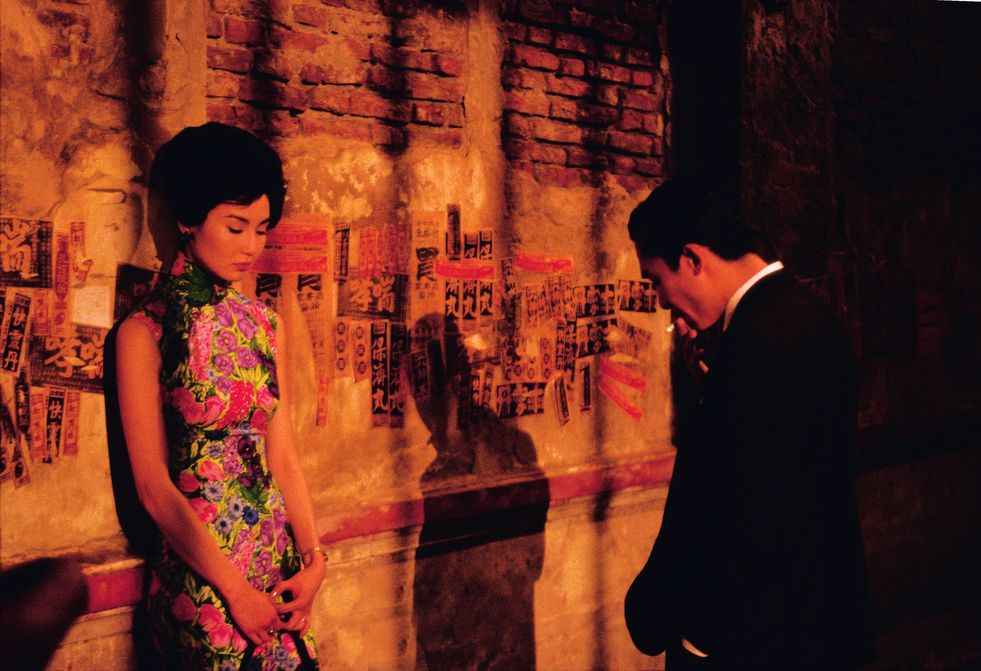
Visual & Sound Diary: In the Mood for Love (2001)


Wrapped in an illustrious blanket of dangerous colour and melody, In the Mood for Love is a dreamy cinematic escapade. Beauty drips from each intrepid detail as the camera glides about, intoxicating its audience with the appeal of intimacy devoid of touch, superseding not desire but sex. Aching in its lustful quality and tortuously enticing in its soft restraint, love is captured not within the limits of a melodramatic story, but fleshed out in all its rawness and urgency, allure buried thick in suggestion and movement. Hong Kong director Wong Kar-Wai's features are classically highly stylised works, appreciative of the paltry, transient quality of dialogue. Instead, he builds pictures resonant in their form, tone and feeling, rebelling against the standards of strongly narrative driven, 30-shots-per-minute sweeping romantic epics. Wong Kar-Wai reminds audiences of the intensity of emotion without event or tragedy. In the Mood for Love is set against the backdrop of a 1960s Hong Kong in an exiled, nostalgic Shanghainese community of narrow alleyways of walls of waxed posters, tiny, cluttered apartments and steaming noodle stalls by night. It tells the tentative tale of a man and women who move into neighbouring apartments with their spouses and grow close over respective suspicions of their partners' infidelity.

The exceptional qualities of the moving imagery are created of not one but two cinematographers: loyal collaborator Christopher Doyle responsible for the iconic slow-motion moving shots while the long shots detailed with fleeting beauties exhibit the handiwork of Taiwanese DoP Mark Lee Ping Bin. The distinctive styles of the filmmakers blend seamlessly into one. The seminal slow-motion montages are heightened by composer, Shigeru Umebayashi's, Yumeji's Theme, blatantly taken from Seijun Suzuki's 90s Japanese independent film, Yumeji. The reuse of an original score crafted for another movie entirely is almost unheard of, but when its cinema giant Wong Kar-Wai behind the camera, the rules of film shall bend. The result, of course, is only the making of a quintessential slow-motion sequence, a vibrant, elegant specimen studied to death at any film school. Drenched in the romance mystery nuance of Alfred Hitchock's Vertigo and the stream of consciousness quality of Andrei Tarkovsky's Mirror, the picture thrives on a consistent visual ambiguity which takes no pleasure or concessions in the idle or the pretentious. The spouses are seen only in silhouettes and heard as convenient voices, the man and woman are never shot in the same frame until the second half of the film. Emotional distance, variance and romantic longing are things to be visualised, not minimised to spoken word. Love has never been depicted so far from the sentimental yet so close to the tangible. Who would've suspected the most romantic film of the 21st century to be an ode to, of all forms of the love, the unrequited and unconsummated kind? 


Thursday, 24 September 2015

Visual & Sound Diary: American Beauty (1999)


A sharply observed social satire, American Beauty is irresistible in its visual diligence, each frame is flagged with vibrant red imagery, the score a spectral body of melodies, signalling the tonal shifts into the character's psychedelic fantasy. Noted for its acidic humour and rich contextualisations- American Beauty is the quintessential antithesis to the classic suburban drama. It mocks the "American dream", the middle-class suburban cage that entraps adults into a life of routine, depression and dangerous comfort. It entails detailed, electric characterisations of real living people but illuminates each with flagrantly original ideas. American Beauty chronicles the tragedy of ordinary life, the dull and uninspired life lead by the working middle-class, those locked down with conditioned obligation, the conventions and superficiality of sedated living. The film can't exactly be pinned as anti-patriotic, but it is a piercing challenge of the generally accepted standards of a contented lifestyle rooted in mediocrity. However, Mendes' social satire isn't all sharp criticism and dark sarcasm, the feature is sparingly laced with simple moments of pure desire for generic goals of happiness, love and fulfillment. And this is exactly what distinguishes American Beauty from other social satires. It is easy to denounce social norms and mock the standards by which most people live, but Mendes goes further with fervent encouragement of active attempts and pursuits for individualistic gratification.  

In crafting my visual and sound diary entries I have always accentuated the imagery over the music but composer Thomas Newman's understated, ethereal score in American Beauty simply bears greater significance than the spectacular work done by DoP Conrad L Hall in Sam Mendes' debut feature. Newman's score is a dynamic expression of its charged content, integral to the achievement of a balance between tone and story, so that his concepts are both rationally based but also emotional in its pursuit. His compositions range from the curiously percussive to the beautifully simple and unadorned piano pieces. Cinematographer, Conrad L Hall, takes great pleasure in shooting dull, painfully basic set designs - bland office rooms and high school hallways, but can just as easily glamourise and enrich these same landscapes with subtle hues of a representative colour, so that every frame serves as an iconic reminder of a landmark film.

Monday, 31 August 2015

Racing Extinction


Documentaries are about achieving an artful balance of persuasion via engaging testimonials, revelatory visuals and the undeniable pleasure of enlightenment. On one end of the spectrum, documentaries which sensationalise events, told with skewed perception and rely on shocking, bizarre imagery - are bias to a fault, sceptisism inevitably invading the audience. But failure to dramatise events for the sake of entertainment results in a stale retellings, the attention of the audience wanes. However documentaries which strike this balance behold beautiful and terrifying powers. They have audiences believing in conspiracies, illuminated by horrible histories, inspired into activism. They can persuade viewers to change their lifestyle, their awareness, their diet. These films are infectious in their conviction and pure in their vision. It is director, environmentalist and photographer Louie Pshioyos who clearly appreciates this - his fascination with the storytelling utility of cinema and its use as a  "weapon of mass construction" is clear. His 2012 docu-drama, The Cove, illuminated our screens with the iconic image of a blood-filled cove, revolutionising the modern documentary genre and went on to become one of the most widely-viewed and awarded documentaries in the history of cinema. Racing Extinction, built on the same potent ambition and avant-garde technical niche, is a sobering tale of a human reality and the ugly future with awaits those selfish and ignorant to its severity.

Racing Extinction throws light on all of the environmental truths most people try to ignore. Director Louie Pshioyos addresses human impact on a faltering environmental by illustrating the grand plan to salvage our dying planet including the small but wonderful ways individual activists have sought change by using their own talents and then highlights the various operations which undermine its entire cause. In many ways, Racing Extinction is a look at Psihoyos own environmental awakening-  how he became conscious, then angry in his conviction and now driven in his pursuit for a future. He champions awareness and action, identifying our current environmental state as a war zone, the apathetic and greedy are the enemies and for once the impending apocalypse upon our loss has some realism attached to it.

Sunday, 2 August 2015

Visual & Sound Diary: Fanny and Alexander (1982)


Director: Ingmar Bergman
DoP: Sven Nykvist
Music by: Daniel Bell

Prolific Swedish director Ingmar Bergman was a visual master, an auteur who worked closely with his faithful cinematographer Sven Nykvist in crafting, if not elaborate colour schemes then dancing shadows of black and white, investing heavily in elaborate production design to achieve his visions. His works range from savage medieval fables and nostalgic road trips to indulgent depictions of identity crises, dying days and the angst of betrayal. His filmography may vary widely in content and story but all of his features explore common concepts of religious faith, sexuality, death, insanity and family. An ever-present yet subtle fantasy element often teases intrigue from the audience, the dialogue is consistently unusual and intuitive and like most excellent films, Bergman's bare a lasting legacy, its retrospective charm particularly strong. 

Fanny and Alexander, sitting at almost 5 hours in length, is Bergman's magnum opus: a sprawling summation of the director most consequential ideas. Fanny and Alexander follows the lives of its two young title characters, who are wrapped up tightly in a curtain of familial comfort. A lively Christmas showcases the large and loving Ekdahl family, each link of the family tree affords a rich array of subplots. The once secure fate of Fanny and Alexander takes a sharp turn when after the sudden death of their father, the children's mother makes an impassioned choice of independence by remarrying into a family of the church. Digital manipulation of imagery and sound is conservative and elementary, Bergman choosing instead to organically create sights for the benefit of the audience, constructing
generous and indulgent sets of parties, plays, wakes and weddings. But Bergman's films were the result of not his exclusive love for visuals but of the marriage between music and imagery. Many of his films showcase an indulgence and infatuation with classical music, from Bach to Chopin, Schumann to Beethoven - the filmmaker evidently favoured romantic and baroque era pieces. For the accompanying music I have selected the opening piece by German composer Robert Schumaan, the second movement to his celebrated, quintessential Piano Quintet in E-flat major, Op. 44.

Sunday, 26 July 2015

Visual & Sound Diary: Apocalypse Now (1979)


Director: Francis Ford Coppola
DoP: Vittorio Storaro
Composer: Carmine & Francis Coppola

Winner of both Best Sound and Best Cinematography at the Oscars in its year of release, this entry to my Visual & Sound Diary requires little justification. The 70s was arguably the most significant decade of American cinema and director Francis Ford Coppola riding in on the New Hollywood wave, managed to close the legendary decade with the greatest war film ever created to this day. Many of the most respected filmmakers have tried their hand at depictions of naval, air or land battles. The result is an array of war movies, each in a distinguished style. Such examples include Steven Spielberg's classic epic Saving Private Ryan, the vague and poetic The Thin Red Line, invariably spawned from the twisted mind of Terrence Malick, Quentin Tarantino's comedic, indulgently violent Inglorious Basterds and of course the unflinchingly brutal Platoon by Oliver Stone. But Coppola's feature, chronicling a man's mission to terminate a rogue US colonel in 1970 Vietnam, supersedes any of these features in place of the ultimate military film. More revelatory, more engaging, more appreciative and exploitative of its cinematic medium, Apocalypse Now is a vivid glimpse into wartime beauty, that summative genre piece which encapsulates perfectly, the singular qualities of war cinema.

Ceremoniously saturated and strangely hallucinatory, Apocalypse Now subtly captures both the physical toll and the mental degradation of soldiers thrown into the violent light of established warzones. Cinematographer Vittorio Storaro utilises spectral imagery to illustrate the unconventionality of the Vietnam war. Perceptions of reality waver in mesmeric ways, the intense humidity traps the soldiers in a deep, idle haze as they travel through Vietnam to Cambodia, experiencing varying sights of air raids, the elaborate destruction caused by a napalm sortie, bridges under attack, a Playboy concert, tribes and villages alight and a Cambodian temple, inhabited by the worshippers of the US colonel, acting as a demigod. It is the feature's narrative arc which distinguishes its unique style, as the key characters of the feature are, for the large duration of the film, merely moving through the conflict.They are, like the audience, mere observers of the hellish landscape and are rarely ever directly involved in combat. Hence, a somewhat dream-like disconnect exists between the viewer and the violence. Striking visuals are accompanied by a stately pop and rock soundtrack with entries such as Shirley and Lee's 50s track "Let the Good Times Roll", The Rolling Stones "(I Can't Get No) Satisfaction" and the classic "Ride of the Valkyries" in the iconic napalm, air raid sequence. Apocalypse Now is a regal film, a hypnotic synchronisation of image and sound.


Sunday, 12 July 2015

Visual & Sound Diary: Ida (2014)


Director: Paweł Pawlikowski
DoP: Łukask Żal, Ryszard Lenciwski
Composer: Kristian Eidnes Andersen

Ida is the product of cinematographers Zal and Lenciwski's love affair with still photography, elaborate framing and natural light manipulation. Darkly moving and silently potent, the feature depicts the hybrid world of 1960s Poland, still scarred by the German occupation of World War II, a time of new world meets old. A trainee nun's exposition to a corrupt, superficial world blossoms in the wake of jazz concerts, young musicians, her worldly and wild aunt, a harsh woman wrapped in cynicism and vanity, and the discovery of the savage history of her late family. The stoic title character Ida is the less intriguing of the two key characters, her aunt Wanda is an evocative figure, both politically and personally. The film panders to the audience's desire to see Ida encounter the intricacies and brutality of the world outside her own by compressing them into the character of her volcanic aunt. For this, an undeniable charm invades the feature, the film afflicted by simple beauties which would, in any other realm, be considered guilty pleasures if not for its religious, political and emotional heft. 

The directors of photography emphasis the backdrop over the subject, faces drift about in the corners of each shot. Each scene is achieved by a single shot, the camera ever static. The visuals are strikingly sharp and vivid, an appreciation of detail is apparent. Moving images stun in variety: from tired parties to baron hospital rooms, stained glass windows, graves, ghost towns, dark forests, baths, places of worship, suicides and slow dances. The imagery is directly reminiscent of Ingmar Bergman. It carries the sentiment of Wild Strawberries and  echoes the religious prowess of Bergman's God's Silence trilogy. Musical contributions are sparse in Ida, the score holds off completely until the end. In this manner, the film is laced with technical symbolism. The cathartic conclusion to the film is marked by the introduction of music and the abandonment of still photography. The imagery whilst austere is hardly mundane. The film illustrates Post-War Poland in a vibrant light, as an era of vivid artistic revolution. The music I wanted to pair with the imagery was "Transcendence" by elusive Dutch composer Jochem Weierink but it is still unavailable to the public. Instead i've selected "Ich Ruf Zu Dir Herr Jesu Christ" (I call to You, Lord Jesus Christ) by Alfred Brendel. 
  

Monday, 6 July 2015

Tangerines


A formula is beginning to take shape amongst acclaimed foreign features. The directional styles of Russian drama Leviathan, Aghar Farhadi's The Past and now Estonian-Georgian feature Tangerines echo each other, their resounding similarities a distraction from their storytelling integrity. Such familiar traits include the use of minimal editing, careful, naturalistic dialogue and mundane goings-on, interrupted by jarring, sensationalist events. They test the viewer's patience, an implied promise of lurid payoff always lingering at the back of our minds. The general intention of this stylistic choice is to assert that such destructive events of suicide, brutalities of civil war and political reverence are jarring, events that can never be expected in the mundane sensibilties of everyday life. This formula is evidently suffice to solicit an Oscar nomination but striking content, the Academy makes clear, is only a baseline requirement. Critics argue greater artistic license should be exercised to distinguish these features, noting the unusual photographic techniques of Ida, the emotional prowess of Blue is the Warmest Color and the decorative, expansive scope of The Great Beauty. So in answering the question of whether this new formula detracts from the quality of the feature? In terms of originality it does devaluate the viewer experience but Tangerines does well in compensating its predictable narrative with absorbing dialogue and a palpable chemistry between rich, layered characters.

Tangerines captures the simple life of an ageing Estonian immigrant, Ivo (Lembit Ulfsak), during the violent conflict of Soviet Russia's dissolution in 1992. He and another immigrant farmer, Margus (Elmo Nüganen), remain in Georgia with the intention of harvesting a final crop of tangerines. But the war advances rapidly, violent conflict befalls on their very doorstep and Ivo takes in two wounded soldiers from opposite sides, Ahmed (Giorgi Nakashidze), a Chechen, and Niko (Mikheil Meskhi), a Georgian. Gratitude and respect for their peaceful saviour keeps bloodshed from inside Ivo's home, vow as they may that once they have recovered and step outside of Ivo's household oasis, war will proceed. 

Wednesday, 1 July 2015

DEAR AFI: Please Consider Rolf de Heer


To the Australian Film Institute,

I would like to make a recommendation for the 2015 recipient of the Longford Lyell Award. Australian filmmaker Rolf de Heer has made numerous invaluable contributions to Australian screen culture, particularly in the sorely underrepresented realm of Aboriginal cinema. His films have sensitively portrayed Aboriginal culture so that it may appeal to and beguile even international audiences, being well received at numerous international film festivals including Cannes Film Festival and Venice FIlm Festival. These films have shed light not only on the rich and cultivating history of Aboriginal culture in such features as "Ten Canoes" but also the tentative modern condition in his recent work "Charlie's Country". His endeavours have also featured a most unique collaborative stream with renowned Australian actor David Gulpilil, the result being resounding pieces of cinema which ring true to Aboriginal custom, illustrating the manner in which colonisation has shaped its contemporary condition. His works have illuminated the all-encompassing faculty of cinema as a means of educating audiences on multi-faceted issues which plague society today and which yield no simple solutions.

Rolf de Heer strives and succeeds to creating not only important films but films which provoke and stimulate its audiences into appreciating native Australian culture. He has fostered significant interest and attention to a salient sector of Australian culture, serving as both reminder and inspiration. For Rolf de Heer to be presented with the Longford Lyell Award would be a timely recognition of his singular efforts to an area of cinema at risk of being marginalised.

I hope that you will consider Rolf de Heer for this honour as both an appreciation of his enrichments of Australian cinema and an encouragement to continue his endeavours. He may not be the only patron of Aboriginal cinema but he is surely its most qualified and dedicated guardian.

Kind regards,


Angela

Saturday, 27 June 2015

Mad Max: Fury Road


The fourth instalment to the Mad Max series, a vigorous reboot of the cult franchise, is an irresistible Western car-chase fever dream, adorned with a delicious, persistent slick of grit and stamped with a brimming, big-budget ego. With smooth and captivating confidence, Mad Max: Fury Road is the holy grail of summer blockbusters, of franchise instalments, of fandom parities. Make no mistake, the feature is tightly secured in its action genre, but perhaps it is the determination to emphasise every genre trademark in zealous rapture that wins over the audience. However atypical and oddly original the feature may be, it is nevertheless recognisable - gas is burned, prizes come in the form of beautiful women and the threat of death lingers near, with terror perpetuated by the ruthlessness of a wretched villain. But only the subtlest and darkest comedic relief is offered, absent are the lingering gags and useless, flimsy character traits to memorise and play on. Only a strong narrative powered by an angry cathartic score and engaging, exorbitant warfare engage the audience with aggressive exuberance. It may not be subtle but it is nonetheless a winning, symphonic recollection of derisive elements thrown together with dubious abandon. 

In the harsh, post-apocalyptic world of Mad Max, women, fuel and water are valuable commodities, harvested and monopolised by the greedy, grotesque cult leader, Immortan Joe. Setup sequences portray this dystopian realm to harbour only the most primitive, brutal type of living - all sanctity of human life is forgone- sexual slavery of women is rampant, men are mere blood-bags for the road warriors and breast milk is gathered systematically from obese women. One-armed road warrior Furiosa seeks to escape the hellish citadel with Immortan Joe's five wives by traveling through the desert wasteland, in hopes of reaching an oasis, the "Green Place".

Sunday, 10 May 2015

Top 13 Films of 2014


An all-encompassing, eclectic year in film, 2014 brought audiences a range of unexpected joys and bitter disappointments. Christopher Nolan delivered Interstellar, a spectacularly spirited but ultimately oversimplified rendition of 2001: A Space Odyssey. Darren Aronofsky polarised critics with his biblical epic, Noah, visually stunning but falling short everywhere else. Tedious, banal British bios The Theory of Everything and The Imitation Game played about in the limelight, warranted by little merit. The year was far redeemed however, by a strong league of independent films, foreign films, (surprisingly) Australian films and arguably the most fun and openly flippant Marvel movie to date, Guardians of the Galaxy. Wes Anderson and Richard Linklater entered the big award leagues for the first time with The Grand Budapest Hotel and Boyhood respectively. 

From over 50 films and 26 reviewed, below are the top 13 films responsible for my insanity in the year 2014.